

CONTRIBUTORS

Chuck Royce
Chairman, Portfolio Manager
United States

Francis Gannon
Co-Chief Investment Officer, Managing Director
Were you surprised that the Russell 2000 Index did so poorly in the second quarter?
Francis Gannon: We were surprised. The Russell 2000 Index fell -3.3% for the quarter, which seemed pretty odd, especially with large-cap stocks continuing to do well—the large-cap Russell 1000 Index gained 3.6%. More important, the US economy remained in good shape, and inflation moderated. So we really can’t point to an external event that would help us make sense of such a dismal quarter on both an absolute and relative basis.
Chuck Royce: Some observers have suggested that small-caps floundered because of the absence of rate cuts. I think that’s a logical but incomplete explanation. For example, many of our holdings have low or no leverage and are therefore not very—or at all—rate sensitive. And while performance for most of our portfolios was better than their respective benchmarks, none was able to outpace large-caps—despite the fact that small-caps continue to be far more attractively valued than their larger peers, based on our preferred index valuation metric of EV/EBIT or enterprise value over earnings before interest & taxes.
Relative Valuations for Small Caps vs. Large Caps Are Near Their Lowest in 25 Years
Russell 2000 vs. Russell 1000 Median LTM EV/EBIT* (ex. Negative EBIT Companies)
From 6/30/99 through 6/30/24
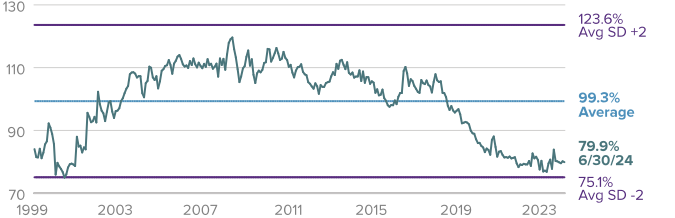
Sources: FactSet, Russell Investments. *Earnings Before Interest and Taxes Past performance is no guarantee of future results.
What factors do you think account for the ongoing strength of mega-cap stocks?
Francis Gannon: I think there are a few reasons, the first being the promise of AI (artificial intelligence). It’s not surprising that Nvidia has emerged this year as the best performer in the mega-cap Magnificent Seven group, given its edge in making the semiconductors that are powering AI applications. There also seems to be a flight from uncertainty into these behemoth names—Alphabet, Amazon, Apple, Meta, Microsoft, Nvidia, and Tesla. So, while the US economy is still in good shape, there’s also a lot of anxiety over the pace of economic growth, inflation, interest rates, the elections, geopolitics, etc. These stocks appear to be impervious to these issues—at least in the minds of their investors. At some point, that may change, but I admit that this run of mega-cap leadership has continued for a longer time than any of us here at Royce anticipated.
What catalysts can you point to that would allow small-caps to recapture market leadership?
Chuck Royce: There’s a lot of attention being devoted to when—or if—the Fed will cut rates this year. However, I don’t see a rate cut being the necessary catalyst. And though I’m sure small-caps would see an uptick in the event of a reduction, I think it would likely be a short-term bump. We see earnings acceleration as being far more likely to spark a lasting small-cap leadership cycle. So, while we sympathize with investors who may be frustrated with the current extended period of small-cap underperformance, we are even more steadfast in our conviction that small-cap will recapture its historical role of outperformance. During this kind of extended leadership period, it’s easy to forget that market cycles are finite, but we have been small-cap specialists with a long-term investment horizon for long enough to know that patience is a critical investment virtue—and that finding attractively valued opportunities during periods of relative underperformance creates the foundation for rewarding long-term results.
What would you say to investors who may be doubtful about small-cap’s long-term prospects?
Francis Gannon: I think we’d start with the fact that active management within small-cap has done well—markedly so in some cases—over the last several years, and this includes our major domestic strategies. Based on this, we think that active managers who focus on earnings growth could remain best positioned for strong performance going forward. The Russell 2000 finished June with a near-record number of companies with no earnings, but earnings acceleration is expected to be higher for small-cap companies than for large-cap businesses through the end of 2024.
Small-Cap’s Estimated Earnings Growth Is Expected to Be Higher in 2024 than Large-Cap’s
1-Year EPS Growth as of 6/30/24
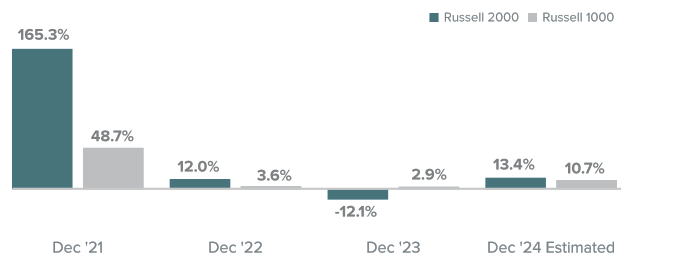
Earnings per share (EPS) is calculated as a company’s profit divided by the outstanding shares of its common stock. The EPS Growth Estimates are the pre-calculated mean long-term EPS growth rate estimates by brokerage analysts. Long Term Growth (LTG) is the annual EPS growth that the company can sustain over the next 3 or 5 years. Both estimates are the average of those provided by analysts working for brokerage firms who provide research coverage on each individual security as reported by FactSet. All non-equity securities, investment companies, companies without brokerage analyst coverage are excluded. There is no assurance that any estimate, forecast or projection will be realized.
This encouraging earnings picture is buttressed by a growing US economy that in the coming months will see more and more tangible benefits from reshoring, the CHIPS Act, and infrastructure improvements. Along with increasing recognition for the small-cap companies that are providing the ‘picks and shovels’ for AI applications, these activities should foster advantages for active small-cap managers who focus on profitable companies and other fundamental measures of financial and operational strength.
Definitions
The Russell 1000 Index is an unmanaged, capitalization-weighted index of domestic large-cap stocks. It measures the performance of the 1,000 largest publicly traded US companies in the Russell 3000 Index.
The Russell 2000 Index is an index of domestic small-cap stocks that measures the performance of the 2,000 smallest publicly traded US companies in the Russell 3000 Index.
The Magnificent Seven stocks refer to Microsoft, Apple, NVIDIA, Amazon, Alphabet Inc., Meta Platforms Inc. Class A, and Tesla.
The CHIPS and Science Act (CHIPS Act) is a US federal statute enacted by the 117th United States Congress and signed into law by US President Joe Biden on August 9, 2022. The act provides roughly US$280 billion in new funding to boost domestic research and manufacturing of semiconductors in the United States.
WHAT ARE THE RISKS?
All investments involve risks, including possible loss of principal. Past performance is no guarantee of future results. Please note that an investor cannot invest directly in an index. Unmanaged index returns do not reflect any fees, expenses or sales charges.
Equity securities are subject to price fluctuation and possible loss of principal.
Commodities and currencies contain heightened risk that include market, political, regulatory, and natural conditions and may not be suitable for all investors.
Small- and mid-cap stocks involve greater risks and volatility than large-cap stocks.
US Treasuries are direct debt obligations issued and backed by the “full faith and credit” of the US government. The US government guarantees the principal and interest payments on US Treasuries when the securities are held to maturity. Unlike US Treasuries, debt securities issued by the federal agencies and instrumentalities and related investments may or may not be backed by the full faith and credit of the US government. Even when the US government guarantees principal and interest payments on securities, this guarantee does not apply to losses resulting from declines in the market value of these securities.
Any companies and/or case studies referenced herein are used solely for illustrative purposes; any investment may or may not be currently held by any portfolio advised by Franklin Templeton. The information provided is not a recommendation or individual investment advice for any particular security, strategy, or investment product and is not an indication of the trading intent of any Franklin Templeton managed portfolio. Past performance does not guarantee future results.
Data and figures quoted in this article sourced from Russell Investments, FactSet, Bloomberg and Reuters.
Important data provider notices and terms available at www.franklintempletondatasources.com. All data is subject to change.